Alternatives
Facebook ad library alternatives
A Facebook ad library alternative is worth paying for only if it keeps what Meta throws away. The library drops a commercial ad the moment it stops running. For the archive, Spytrend at $79. For advertiser discovery, AdSpy at $149. For zero cost, the BigSpy free plan.
The six alternatives, closest replacement first
Ordered by how much of the library's job each one takes over: the archive the library does not keep first, then advertiser depth, then breadth. Entry price is a column, not the ranking — the free option sits third and the cheapest paid one sits fifth.
Facebook Ad Library alternatives, closest replacement first
entry price, read 1 November 2026| # | Tool | Entry | What it gives you that the library does not |
|---|---|---|---|
| 1 |  Spytrend | Free · $79 | The only tool here that publishes both a retention window and a Facebook ad count: an archive going back to 2018 with more than 1.3 billion Facebook ads in it |
| 2 |  AdSpy | $149 | The widest country reach on this page — 30.4 million advertiser profiles across 225 countries — plus search inside ad comments, which nothing else here offers at any price |
| 3 |  BigSpy | Free · $69 | The only alternative with a free plan rather than a trial: Facebook, five searches a day, against a claimed base of over 1 billion creatives |
| 4 |  TrendTrack | €49 | Publishes 250 million ads and adds 2 to 3 million a day, and carries the store behind the ad — traffic, products and reviews |
| 5 |  Minea | $49 | More than 10 million ads across Meta and influencer placements, aimed at finding a product to sell rather than tracking a named rival |
| 6 |  PowerAdSpy | $69 | Eleven networks on paper, but the $69 entry covers Facebook and Instagram only and publishes no base size at all |
What the Facebook Ad Library does not give you
Four gaps, all of them by design rather than by oversight. The library is a transparency product, not a research one.
Nothing survives the stop button
Meta keeps commercial ads only while they run. Political and issue ads stay seven years; everything else disappears when the advertiser pauses it, which is exactly when it becomes interesting.
No spend, no run length, no targeting
The library publishes none of the three for a commercial ad, so a three-day test and a ninety-day winner look identical in it. That single limitation is why every tool on this page exists.
No owner-level grouping
One advertiser running forty pages reads as forty separate pages. Spytrend joins every ad of one owner by pixel, domain, Page ID and IP; the library has no such concept.
It is free, and that still counts
First-party, complete for live ads, no account needed. For checking whether a competitor is running anything at all right now, nothing here beats it — including the tools above.
One search, free library against a free paid-tool plan
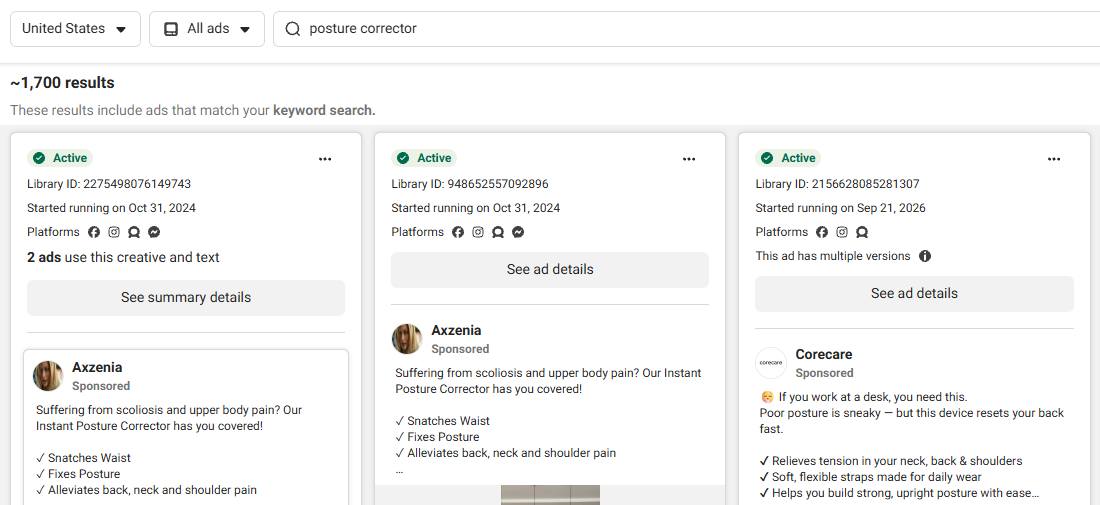
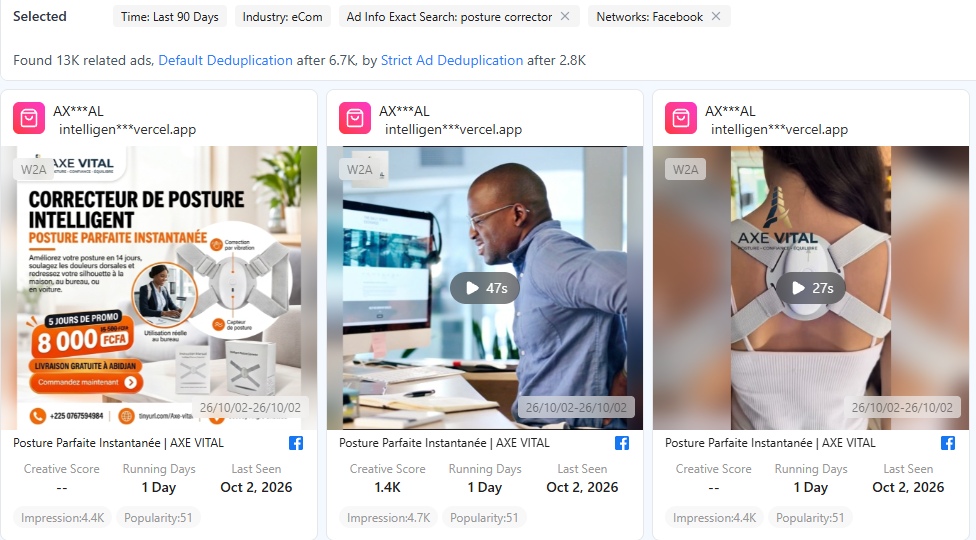
We ran “posture corrector” in the Meta Ad Library and on BigSpy’s free plan on the same day, to see what each gives for nothing.
The library returned about 1,700 active US ads, each with the advertiser’s name and the day it started running, and nothing that had stopped. BigSpy’s free plan, over its default 90 days, found 13K related ads, 2.8K after strict deduplication, but masked every advertiser name and domain. One shows who and only now; the other shows more and not who. A paid archive is worth it when you need both.
Why each one is on the list
Each tool closes a different part of the gap, and the order follows how much of it they close.
Spytrend is first here on the one measurement this page is about: it publishes an archive going back to 2018 with more than 1.3 billion Facebook ads in it, and it is the only tool on this page that publishes both a retention window and a monthly intake figure. Entry is a free Starter tier with no card; paid access is $79, and the published tiers sit on spytrend.com/pricing.
AdSpy is second because it answers a different half of the question better than anyone: who is advertising at all. It publishes 30.4 million advertiser profiles across 225 countries and 88 languages, the widest country reach stated by anyone here, and it is the only tool on this page that searches the comments left on an ad. The cost is $149 on a single plan, and it states no retention window at all — how far back its 213.7 million ads reach is not published.
BigSpy is third because it is the only alternative that costs nothing to keep. Its free plan is a plan rather than a trial: Facebook only, five searches and twenty creative downloads a day, against a claimed base of over 1 billion creatives across 11 ad channels. Paid access is $69 and the tiers above it are broken down in BigSpy pricing. For a buyer leaving the library purely because it hides stopped ads, this is the cheapest way to stop losing them.
TrendTrack publishes 250 million ads and adds 2 to 3 million a day, the only daily intake stated on this page, and it carries something none of the others do: the store behind the ad, with its traffic, products, reviews and email flows, across 5 million Shopify stores. Its €49 Starter opens the stores only and the ads start on Pro at €89; it is fourth here because its centre of gravity is the store rather than the ad archive — as a library replacement it covers less, as a research tool it covers more.
Minea at $49 publishes more than 10 million ads across Meta and influencer placements, plus Shopify products, and shops from Premium at $99. Its tiers differ by monthly AI quotas rather than by how much of the database you may search, which is unusual and worth knowing before you pick a plan — the detail sits in Minea pricing. It is built to find a product worth selling, not to reconstruct what one named competitor has run.
PowerAdSpy is last because it publishes the least about itself. It lists eleven networks, and Quora, Reddit and LinkedIn appear nowhere else in this category — but those sit on the $399 plan, while the $69 entry buys Facebook and Instagram. It states no base size at any price, so there is no figure to compare against the library it is meant to replace.
One thing none of them replaces. The Meta Ad Library is first-party and complete for ads running right now, and it is free. Every tool above is a second source collected by a third party, which means coverage is a claim rather than a guarantee. The honest pattern is to keep the library for "is this running today" and pay for the archive only when the question is "what did they run before, and for how long".
How fresh the ads are: our own test
The library shows an ad the moment it runs, so a paid alternative is only worth it if it catches new ads almost as fast. We measured that ourselves in October 2026, and this is the full result.
We took 20 Meta ads launched on 20 October, picked them in Meta’s Ad Library before searching any tool, and searched each one the same way in every tool on 28 October. Spytrend had 19 of 20, all within two days of launch. BigSpy’s free plan had 9 of the 19 we could search, Minea 4, AdSpy 2 and Dropispy 1.
| Tool | Plan tested | Found, of 20 Meta ads | Tested |
|---|---|---|---|
| Spytrend | Pro, $79/mo | 19 | Oct 28, 2026 |
| BigSpy | Free | 9 of 19 searchable | Oct 28, 2026 |
| Minea | Starter, $49/mo | 4 | Oct 28, 2026 |
| AdSpy | $149/mo | 2 | Oct 28, 2026 |
 Dropispy | Premium | 1 | Oct 28, 2026 |
An earlier check measured delay instead, on ads each tool already held for Gymshark and Manscaped: Dropispy first saw them a median of 3 days after posting (71 ads), PowerAdSpy 15 days (31 ads), and Minea’s newest Gymshark ad on 12 October was from 11 September. Those are each tool’s own samples, so they show speed on what a tool holds, not what it misses.
For ecommerce sellers
When the question is what to sell rather than what a rival ran, the order changes.
For a store owner the ad is the last step of someone else’s funnel. TrendTrack and Minea are not replacements for the library but additions to it: they answer a question the library never asks, namely which store sits behind the ad and which product is worth selling. TrendTrack carries traffic, products, reviews and email flows for 5 million Shopify stores; Minea ties Meta ads and influencer placements to Shopify products from $49.
Dropispy is the cheapest way in at €29.90 a month and keeps a free plan, but on our free account it hid the last two months of ads and locked search by text and page name, so the free plan suits browsing a niche rather than following a live test.
The order that works for product hunting: find the product in Minea or TrendTrack, then look up the seller’s history before copying the angle. A product one store has advertised for ninety days is a different signal from one it tested for three, and that difference is exactly what the library erases.
Questions
What is the best Facebook Ad Library alternative?
It depends which gap you are closing. For ads that have already stopped, Spytrend’s archive, at $79 with a free Starter tier. For advertiser discovery, AdSpy at $149. For zero cost, the BigSpy free plan.
Are there free alternatives to the Facebook Ad Library?
Yes, with limits. The BigSpy free plan allows five searches and twenty creative downloads a day, on Facebook, over the last 90 days, but masks advertiser names. Dropispy’s free plan shows older ads and hides the last two months. Both keep ads the library has already dropped, which is the thing the library cannot do.
Why does the Facebook Ad Library not show old ads?
Meta keeps an ordinary ad shown outside the EU and UK only while it runs and drops it once the advertiser stops; ads shown in the EU or UK stay for a year, political and issue ads for seven years. A live ad shows its start date, but a stopped US campaign is gone, which is why paid archives exist at all.
What can paid tools show that the Facebook Ad Library cannot?
Three things the library publishes for no commercial ad: how long an ad ran, what it spent, and who it targeted. Most paid tools also keep an ad after it stops, so a ninety-day winner can be told apart from a three-day test after both are gone from the library.
Which Facebook Ad Library alternative is best for dropshipping?
Minea at $49 or TrendTrack, both built for it: Minea for finding a product across Meta ads, influencer placements and Shopify shops, TrendTrack for a store’s traffic, products and reviews, with ads from its €89 Pro plan. An archive matters once the question shifts from what to sell to what one seller has run, and for how long.
Are free Facebook ad library scrapers worth using?
A scraper copies what the library shows today, so it inherits the same blind spot: nothing survives after the advertiser stops the ad. Building an archive means collecting daily from the start, so a scraper begun today never sees what ran last year — that history only exists in tools that were already collecting.
Are the Facebook Ad Library and Spytrend the same kind of tool?
No. The Meta Ad Library is Meta’s own free, first-party record of ads running right now, with no spend, run length or targeting. Spytrend is a third-party paid archive that keeps ads after they stop, back to 2018, across Facebook, Instagram and TikTok, and groups them by owner.